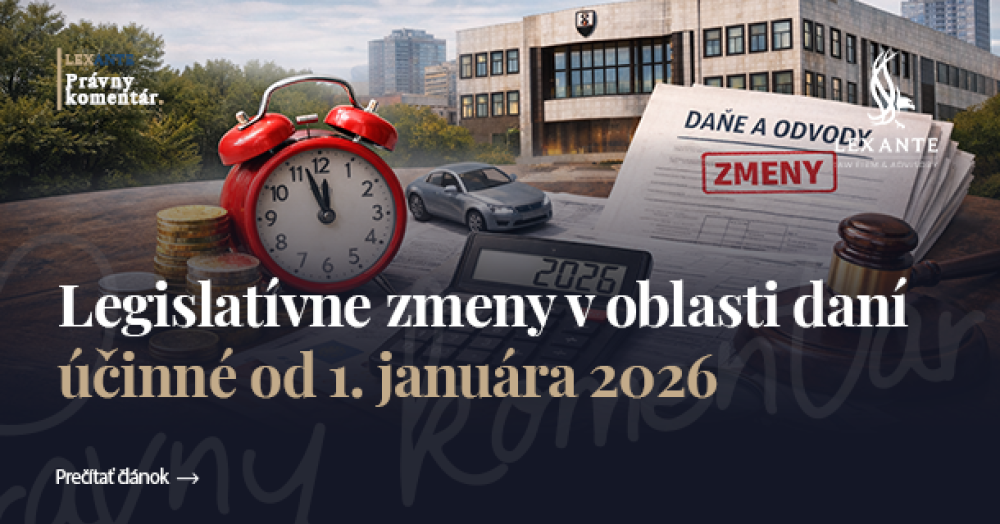
Legislative Changes in the Area of Taxation Effective from 1 January 2026
During the autumn of 2025, several significant legislative changes in the field of taxes and levies were adopted, which will come into effect as of 1 January 2026. These measures constitute a comprehensive set of reforms aimed at consolidating public finances, adjusting the tax burden of selected sectors of the economy, and increasing the transparency of financial flows. Following their approval by the National Council of the Slovak Republic and signature by the President, the amendments will become effective upon their publication in the Collection of Laws.
In the area of corporate income tax, several substantial changes are being introduced. The system of income compensation during temporary incapacity for work is being modified, whereby the Social Insurance Agency will provide compensation only after the first fourteen days, with the employer remaining responsible for compensation during this initial period. In cases where an employee’s incapacity for work commenced before 1 April 2026 and continues thereafter, the previous legal framework will continue to apply. Changes also affect the deduction of investment expenses, as the period for which an investment plan may be prepared is extended from six to nine years, with the final taxable period extended until 2030. At the same time, it is stipulated that non-deductible value added tax arising from private use of a motor vehicle in the period from 1 January 2026 to 30 June 2028 will not constitute a tax-deductible expense for corporate income tax purposes.
A significant amendment is the introduction of a minimum corporate income tax in the form of a tax license, which will also apply to entities with taxable revenues exceeding five million euros. The amount of the minimum tax will depend on the level of taxable revenues and is intended to ensure a minimum level of tax contribution even from the largest and economically strongest business entities. A specific adjustment is also introduced in the gambling sector, where the corporate income tax rate is increased to 54% for banks and branches of foreign banks generating income from fees charged for card payment transactions where the funds are credited to gambling accounts.
Changes in the area of value added tax primarily concern motor vehicles used for both business and private purposes. A temporary option is introduced to apply a flat-rate VAT deduction of 50% on the acquisition and operation of selected motor vehicles during the period from 1 January 2026 to 30 June 2028. At the same time, record-keeping obligations are tightened, as VAT payers will be required to maintain electronic records of each journey and submit them to the tax authority upon request. The legislation expressly provides that the non-deductible portion of VAT will not qualify as a tax-deductible expense. With regard to VAT rates, certain food products with excessive levels of salt and sugar are moved to the standard VAT rate, while the scope of periodical publications eligible for the reduced VAT rate is expanded.
Substantial changes are also introduced in the area of the financial transaction tax. As of 1 January 2026, only legal entities will remain taxpayers of this tax, while self-employed individuals will cease to be subject to it. The legislation introduces new definitions of taxpayers with limited and unlimited tax liability, a specific definition of a permanent establishment for the purposes of this tax, and clarifies the scope of taxation of domestic and foreign transactions. The amendments also include stricter liability rules concerning incorrectly designated payment accounts intended for transactions excluded from the tax base.
In the area of the special levy in regulated industries, the scope of regulated entities subject to the levy is expanded to include pension management companies, supplementary pension companies, and collective investment management companies. A specific levy rate is introduced for these entities, and where an entity operates in multiple regulated areas, the highest applicable rate will be applied.
The amendments also affect travel allowances, granting the Ministry of Finance broader authority to determine the amount of meal allowances for foreign business trips. In addition, the possibility of agreeing on a reduced meal allowance is expanded in cases where frequent changes of workplace result from the specific nature of the employee’s profession.
Particular attention should also be paid to the introduction of a tax amnesty effective from 1 October 2025. This measure allows taxpayers to settle tax arrears recorded as of 30 September 2025 without penalties, provided that payment is made within the statutory period in the first half of 2026. The amnesty also applies to late-filed and additional tax returns for earlier taxable periods, with the objective of stabilizing tax relations and increasing voluntary tax compliance. This measure does not apply to local taxes and fees administered by municipalities.